
AI readiness assessment: six checks before you approve one workflow

The short answer: You have picked one workflow. Before you approve a pilot, collect proof on six things. The delay is measured. Real examples are in hand. Access is granted and tested. Someone owns the exceptions. Success is written as a test. There is a way back.
The decision this helps you make
Approving an AI project is a spending decision and a risk decision. One possible business case is the next hire you avoid. Volume grows, and an agent takes the repeat work instead of another person. That counts as value only when the work is really absorbed, and only after you subtract what the automation costs to run. Hours freed with no change in headcount or pay are capacity, not cash. Capacity can still be worth having if you know where it goes.
The six checks do not tell you whether that value exists. They tell you whether this workflow is ready for a fair test. Whether the test is worth paying for is a separate question. It depends on what the work costs you now, what a pilot would cost, and what you would do with the time. Check 1 gives you the first of those numbers.
What this assessment covers
It covers one workflow, for example emailed purchase orders going into an order system. It does not rate your whole company. It does not help you choose a workflow, compare tools or estimate cost. If you haven't picked yet, start with where to start.
Passing all six makes the workflow a candidate for a pilot in which a person reviews the agent's work. That is a reason to test. It is not a forecast of results.
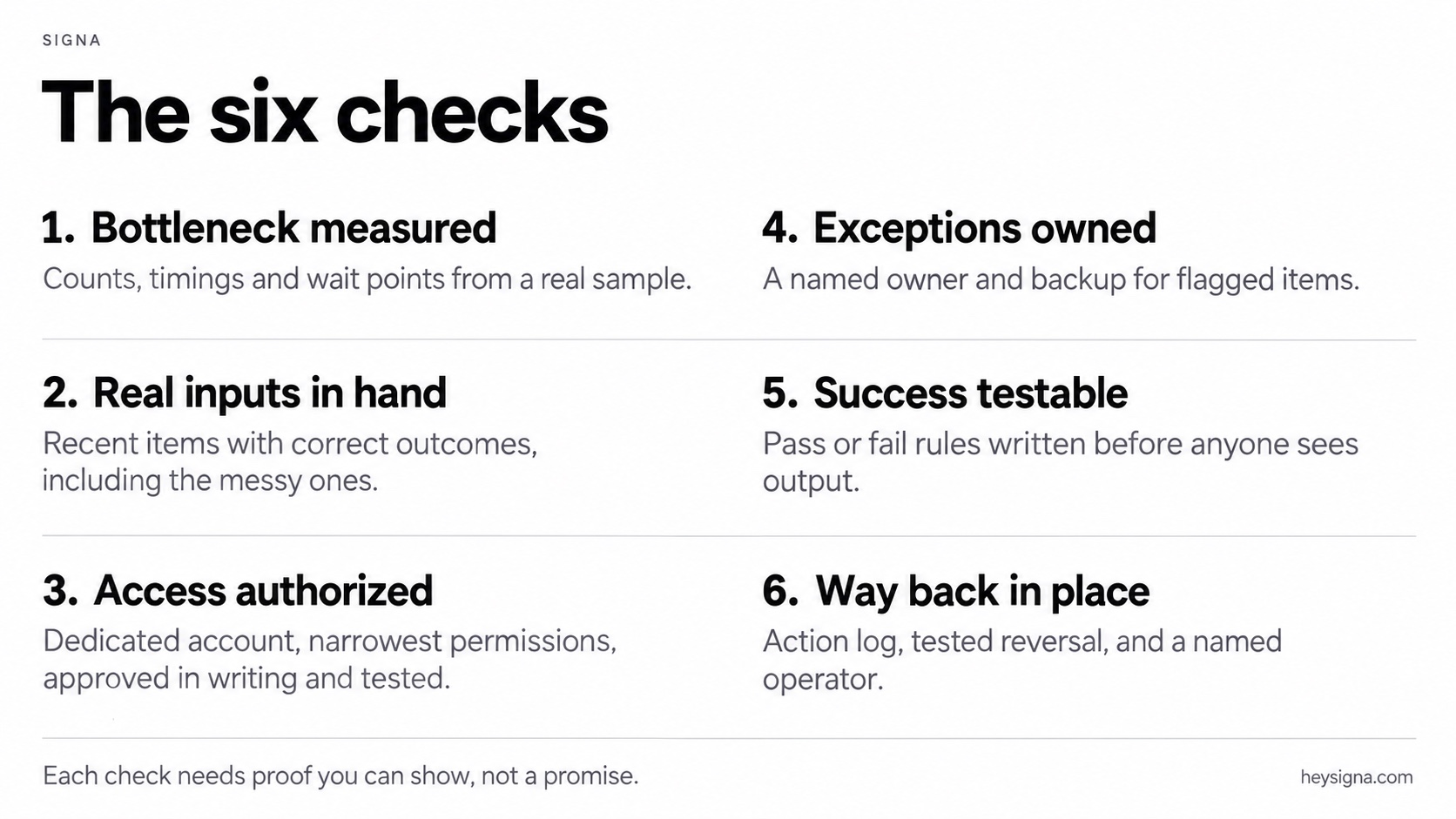
- 1. Bottleneck measuredCounts, timings and wait points from a real sample.
- 2. Real inputs in handRecent items with correct outcomes, including the messy ones.
- 3. Access authorizedDedicated account, narrowest permissions, approved in writing and tested.
- 4. Exceptions ownedA named owner and backup for flagged items.
- 5. Success testablePass or fail rules written before anyone sees output.
- 6. Way back in placeAction log, tested reversal, and a named operator.
1. The bottleneck is measured
What to collect: a sample of the current record that includes ordinary days, a busy stretch and the odd cases. Note items per week, time per item, who touches each one, and where items wait. A spreadsheet export is enough.
Red flag: everyone agrees the work is slow, but no one can say how slow or where.
Next action: pick the sample with the person who does the work. Measure by hand before anything is built. Without a baseline, you can't tell later whether the pilot took on any work.
2. Representative inputs are in hand
What to collect: actual items from recent months, each with the correct outcome written beside it. Include the messy ones: odd formats, missing fields, scans.
Red flag: only clean examples exist, or the person sponsoring the project chose the set.
Next action: ask the person doing the work for a random batch, plus the items they dread.
3. Access is authorized
What to collect: each system the workflow touches, what must be read, what must be written, who approved that access in writing, and a test showing the account can do those things.
Red flag: the plan relies on a shared login, a personal account, or a system IT hasn't heard about. Access that is promised but not yet granted and tested counts too.
Next action: request a dedicated account with the narrowest permissions that still work, then test it.
4. Exceptions have an owner
What to collect: the name of the person who takes items the agent can't or shouldn't handle, and what they do with those items today.
Red flag: the answer is that the team handles it.
Next action: name one person and one backup. Write down how an item reaches them and what they decide.
5. Success is testable
What to collect: written pass or fail rules, run against the set from check 2. State what counts as correct, which errors you can tolerate, and which are never acceptable.
Red flag: the standard is that it should feel right, or the rules get written after someone has seen the output.
Next action: write the rules first, then run the set. Testing AI agents covers the method.
Acceptance examples, all hypothetical:
- A missing part number goes to the exception owner. The agent does not fill it in.
- Every quantity and total matches the source document on every item in the test set.
- A customer match that is uncertain is flagged, not chosen.
- Nothing goes outside the company until a person approves it.
6. There is a way back
What to collect: a plain description of what happens when the agent stops or gets something wrong. You need a log of everything the agent does, a way to reverse bad output, and a named operator who can take over and switch the agent off.
Red flag: the old process has been retired and nobody remembers how to run it, or the agent's actions can't be logged. Keeping some manual work going is not enough by itself. If the log, the reversal or the operator is missing, you can't yet show that you can recover.
Next action: build the log, test the reversal on a sample, and name the operator and a backup.
Not every action can be undone. Some can't be recalled once they happen, such as an email delivered to a customer or a filing submitted to a regulator. Others can sometimes be reversed, but at a cost: a refund already issued, a payment sent to a vendor, a record that has been deleted. Whether they can be recovered depends on your systems, your bank and your backups. List both kinds for your workflow and note how hard each is to reverse.
During the pilot, a person approves every action on that list. After it, decide scope on purpose, one action at a time. Weigh the damage a mistake would do, how hard it is to undo, and the error record from the pilot. Some low-risk, easily reversed steps may earn the right to run without review. Others may stay with a person. Make that call with evidence, not by default.
A hypothetical example
Illustration only. No real business or result.
A regional distributor wants an agent to read emailed purchase orders and enter them in its order system.
- Check 1: the office manager has counts and timings covering a normal stretch and a month-end rush. Ready.
- Check 2: a folder of past orders exists, including scans, each with the entered result. Ready.
- Check 3: IT says it will issue a limited account. That is a promise, not a tested account. Not proven yet.
- Check 4: orders with a missing part number go to whoever notices first. Red flag.
- Check 5: nobody has written down what a correct entry is. Red flag.
- Check 6: staff will keep keying orders by hand, but there is no log, no reversal method and no named operator. Not proven yet.
The conclusion is fix first. The owner gets the account granted and tested, names an exception handler, writes the acceptance rules, and sets up the log, reversal and operator. Then they run the check 2 folder against the rules and fill in the worksheet again.
The decision rule
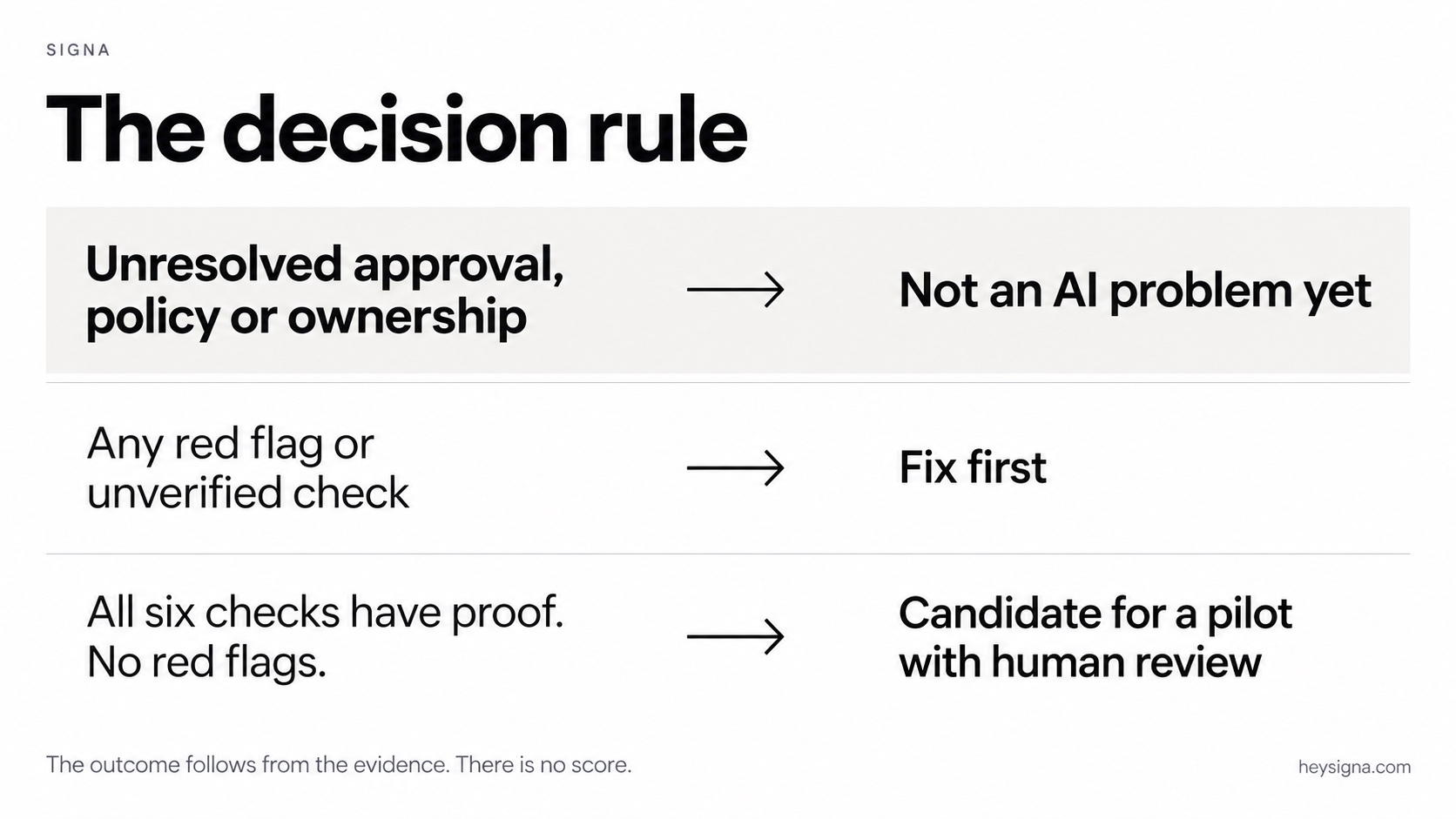
- Pilot with human reviewAll six checks proven and no unresolved process decision.
- Fix firstAny red flag, unverified check, or missing evidence note.
- Not an AI problem yetDelay comes from an unresolved approval, policy or owner.
- Candidate for a pilot with human review: all six checks have proof and no red flag. The pilot is limited, a person reviews the agent's work, and actions that can't be undone wait for approval. Widening scope is a separate decision, made afterward on the pilot's results.
- Fix first: any red flag, or any check you can't yet prove, including a delay that has never been measured. Close each gap, then run the worksheet again.
- Not an AI problem yet: check 1 shows the time goes to waiting on an approval, a policy nobody has set, or a handoff nobody owns. Settle the ownership first. Automation can help with routing or reminders once someone owns the step. It can't make a decision nobody has the authority to make.
Once the worksheet passes, workflow automation explains how the pieces connect.
Check one workflow
Use this for the one workflow you have already selected. For each check, add a reference to your evidence and mark its status. Your answers are self-reported and have not been validated.
Nothing you enter is saved or sent. Results are self-reported, not validated. Print or copy your notes before you leave this page.
Incomplete
Enter the workflow name, choose a status for each of the six checks, and answer the process question.
Open gaps
Select and copy the text below.
Blank worksheet
Copy this for one workflow at a time. For status, use evidenced when you can show the proof, unverified when it is promised or assumed, and red flag when the check fails.
WORKFLOW READINESS WORKSHEET
Workflow (one, already selected):
Workflow owner:
Reviewer and date:

1. Bottleneck measured
   Sample period and what it covers (ordinary days, busy stretch, odd cases):
   Items per week:
   Time per item:
   Who touches each item:
   Where items wait:
   Evidence (file, export or link):
   Status (evidenced / unverified / red flag):
   Next action, owner, date:

2. Representative inputs in hand
   Number of real items and their date range:
   Correct outcome written beside each item? (yes / no):
   Messy cases included (odd formats, missing fields, scans):
   Who chose the set:
   Evidence (file, export or link):
   Status (evidenced / unverified / red flag):
   Next action, owner, date:

3. Access authorized and tested
   Systems the workflow touches:
   What must be read and written in each:
   Dedicated account with narrowest permissions? (yes / no):
   Who approved the access, and where it is in writing:
   Test showing the account can do these things (date, result):
   Status (evidenced / unverified / red flag):
   Next action, owner, date:

4. Exception owner and backup named
   Exception owner:
   Backup:
   What counts as an exception:
   How an item reaches the owner:
   What the owner decides:
   What happens to these items today:
   Status (evidenced / unverified / red flag):
   Next action, owner, date:

5. Acceptance rules written before testing
   Date the rules were written, and was it before anyone saw output? (yes / no):
   What counts as correct:
   Tolerable errors:
   Never-acceptable errors:
   Test set used (from check 2) and result of the run:
   Status (evidenced / unverified / red flag):
   Next action, owner, date:

6. Way back in place
   Action log (what it records, where it lives):
   Reversal method:
   Reversal tested on a sample (date, result):
   Operator who can take over and switch the agent off:
   Backup operator:
   Manual process still documented and runnable? (yes / no):
   Status (evidenced / unverified / red flag):
   Next action, owner, date:

Actions that cannot be recalled, and who approves each during the pilot:
Actions that are costly or difficult to reverse, how hard each is, and who approves each during the pilot:
After the pilot: which actions might run without review, on what evidence, decided by whom, and when:

Decision (candidate for pilot with human review / fix first / not an AI problem yet):
Reason:
Open gaps and date to run this worksheet again: